
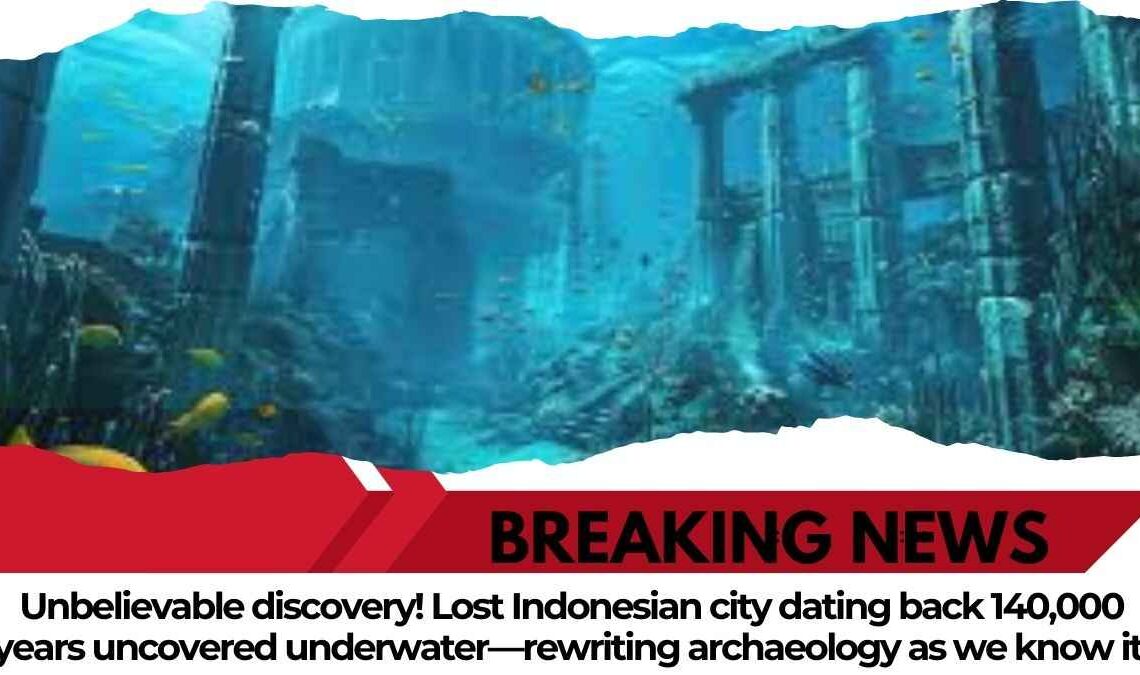
Scientists have discovered buried beneath the sea off the coast of Indonesia that can recreate the history. The scull of Homo erectus, an ancient human anciestor, have been discovered beneath the sea. The human ancestor was found in the Madura Strait between Java and Madura.
The discovery of the hidden city at the bottom of the ocean may be the first physical evidence of the lost world. Apart from the scull of Homo erectus, the scientists have found 6,000 animal fossils of 36 spices. These include deer, buffalo, Komodo dragons, and elephants.
The skull is thought to have been laid to rest 140,000 years ago. According to some reports, it was conserved beneath the layers of silt and sand in Madura Strait. Some of the discovered animal bones had cut marks, which reveal the proof of early humans practising hunting strategies.
Indonesia’s hidden city gives an insight into Sundaland, the lost world landmass that previously connected South Asia to a vast plain. The scientists get ideas from the fossils and insights into the behaviours of ancient humans. They also get ideas about how humans adapted to environmental changes.
Originally, they were discovered by maritime sand miners in 2011. Scientists recently established their age and species. These fossils mark an important milestone in paleoanthropology.
Harold Berghuis, an archaeologist at the University of Leiden in the Netherlands, said that this period is characterised by great morphological diversity. He also added that these fossils are evidence of hominin populations in the region.
The sea levels rose between 14,000 to 7,000 years ago because of the melting glaciers. After this incident, the low-lying plans of Sundaland were submerged. Since dredging occurred during marine sand mining, workers found over 6,000 vertebrate fossils and two human skull pieces at a site near Surabaya.
Scientists then discovered a buried valley system from the earlier Solo Rover. Later, the scientists analysed the sediment layers and discovered some indications of a thriving river ecosystem during the late Middle Pleistocene.