
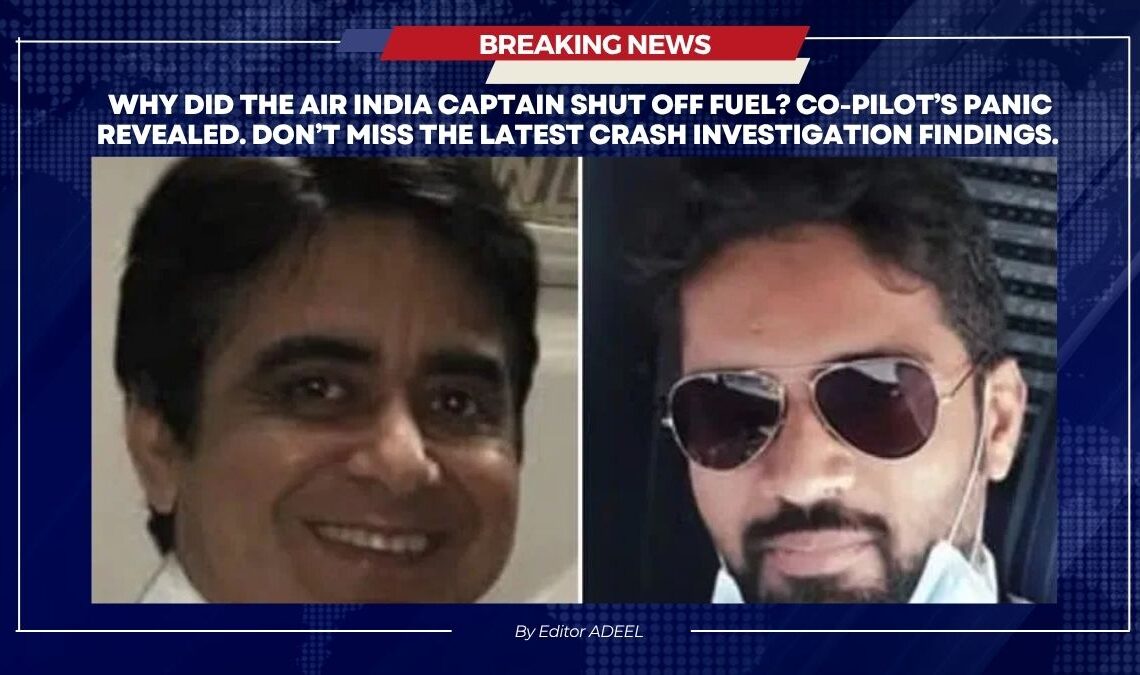
US officials think the captain of the drowned Air India aircraft probably shut off the fuel supply before the plane crashed in Ahmedabad. According to an analysis of the black box data by the United States, the first officer flying the Boeing 787-9 asked why the captain had switched switches to the cut-off position.
The captain stayed composed, while the first officer showed shock and fear, according to the Wall Street Journal.
When the Boeing 787 Dreamliner crashed into a medical student hostel in a densely populated suburb last month, less than a minute after taking off from Ahmedabad airport, Ll 242 people on board were killed, save for one.
It follows the Aircraft Accident Investigation Bureau (AAIB) ‘s preliminary study, which indicated that controls regulating the fuel flow to the jet’s two engines were deactivated, leading to a disastrous loss of performance during takeoff.
The article claims that in the retrieved cockpit audio tape, one of the pilots can be heard asking the other, “Did you cut off the fuel flow.
In response, the other pilot said he “didn’t”. Previously, it was unclear who said what.
The Wall Street Journal was informed by US sources who have listened to the voice recordings in the cockpit that the captain was asked why he stopped the engines’ gasoline supply.
According to the study, the switches were moved one second apart. The switches were turned back on after about ten seconds. Whether the switches were switched off on purpose or by mistake was not mentioned in the study. The Co-Pilot, Clive Kundar, and the captain, Sumeet Sabharwal, had flown together for almost 9000 hours.
The Telegraph reported on Sunday that investigators looking into the Air India tragedy were reviewing Mr. Sabharwal’s medical records in light of allegations that he had mental health issues and despair.
After his mother passed away in 2022, 56-year-old Captain Sabharwal had been thinking of quitting the airline to care for his ageing father.
Just before the catastrophe, Mr. Sabharwal sent out a mayday call. All communication was lost, though, until the plane had risen as high as 400 feet over the runway. After that, the aircraft plummeted towards the earth and burst upon impact.
Captain C.S. Randhawa, the federation’s president, said: “The report, as released, lacks comprehensive data and appears to rely selectively on paraphrased cockpit voice recordings to suggest pilot error and question the professional competence and integrity of the flight crew.
“This approach is neither objective nor complete. Assigning blame before a thorough, transparent, and data-driven investigation is both premature and irresponsible.”
The collision was Boeing’s Dreamliner’s first deadly accident. However, a series of safety and quality issues had already hurt the airline’s reputation.