
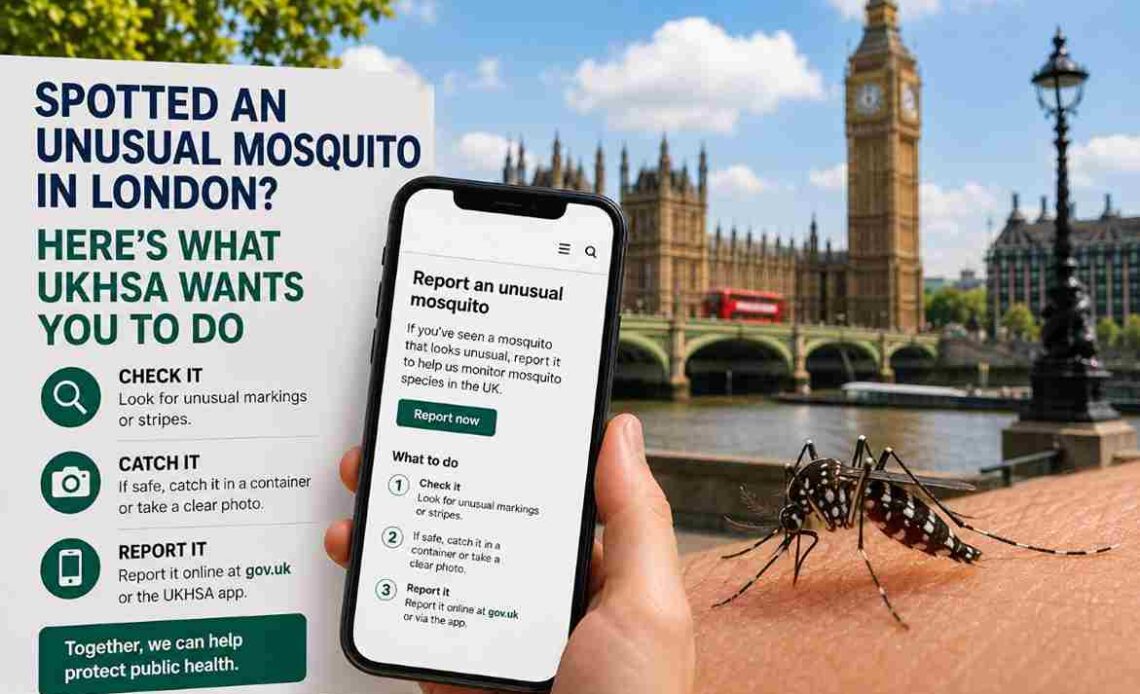
Spotting a mosquito in London is hardly unusual during warmer weather. But if the insect looks noticeably different from the mosquitoes you normally see, the UK Health Security Agency (UKHSA) is asking residents to take a closer look — and, where possible, report it.
The advice comes after Aedes aegypti, an invasive mosquito species capable of transmitting diseases including dengue, chikungunya and Zika in countries where those infections circulate, was found breeding at residential properties in east London. UKHSA says the current risk to the public is very low, with no evidence that the mosquitoes have caused human infections. (GOV.UK)
What’s actually true
The east London discovery is significant because it is the first time Aedes aegypti has been found breeding in the UK. UKHSA says it is the fourth time the species has been detected in the country in recent years.
Importantly, this does not mean London has suddenly become a dengue hotspot. Finding a mosquito species capable of carrying viruses is different from finding mosquitoes that are infected with those viruses.
UKHSA believes the mosquitoes are likely to have been accidentally imported, potentially arriving in vehicles, luggage or imported plants. Although recent heatwaves may have provided suitable conditions for breeding, the agency says Aedes aegypti is not established in the UK and is unlikely to survive long-term under the country’s usual climate. (GOV.UK)
The discovery has nevertheless triggered enhanced trapping and surveillance in the affected area, alongside measures to remove mosquito larvae and look for further mosquitoes.
Why UKHSA wants Londoners to report unusual mosquitoes
This is where the public can make a useful contribution.
UKHSA runs Mosquito Watch, a surveillance scheme that allows people to report mosquitoes and submit photographs or specimens. The scheme is specifically designed to help identify unusual or invasive species and improve understanding of where different mosquitoes are found. (GOV.UK)
That matters because identifying an invasive mosquito early allows health authorities to investigate and, where necessary, take action before it becomes established.
However, appearance alone can be misleading. UKHSA notes that common British mosquitoes are sometimes mistaken for invasive species. For example, the large and conspicuous Culiseta annulata is frequently misidentified as the Asian tiger mosquito. (GOV.UK)
Don’t assume every black-and-white mosquito is dangerous
One of the biggest misconceptions is that seeing a striped or unusual-looking mosquito automatically means it is an invasive species.
The Asian tiger mosquito, Aedes albopictus, for example, is small and black-and-white and tends to bite during the daytime. Its eggs have previously been detected in parts of south-east England, but UKHSA says it has not become established in Britain. (GOV.UK)
Nor does a mosquito bite itself prove that someone has caught a mosquito-borne illness. In its current Mosquito Watch guidance, UKHSA says the scheme does not routinely test submitted mosquitoes for pathogens. (GOV.UK)
What to do if you spot one
If you see a mosquito that looks unusual, particularly if it appears different from the common mosquitoes you normally encounter, take a clear photograph if you can do so safely and report the sighting through UKHSA’s Mosquito Watch scheme.
UKHSA accepts photographs and, where appropriate, mosquito specimens. Residents can also help reduce breeding opportunities around their homes by emptying standing water from buckets, containers, paddling pools, plant pots and other outdoor items. (GOV.UK)
There is no need to panic or attempt to identify a mosquito with certainty yourself. Reporting the observation allows specialists to assess it.
For people concerned about mosquito bites generally, sensible precautions include covering exposed skin, using an appropriate insect repellent and reducing standing water around outdoor spaces. (UK Health Security Agency Blog)
The bigger picture for London
The discovery is a reminder that mosquito surveillance is becoming increasingly important as international travel, movement of goods and changing environmental conditions influence where some species can survive.
UKHSA’s surveillance programme already monitors mosquito populations across the country, while recent national surveillance has also highlighted the need to watch for mosquito-borne viruses such as West Nile virus and Usutu virus. (GOV.UK)
The key takeaway: an unusual mosquito in London does not automatically represent a health emergency. But reporting it can help specialists detect invasive species early, which is precisely why UKHSA is asking the public to get involved.