
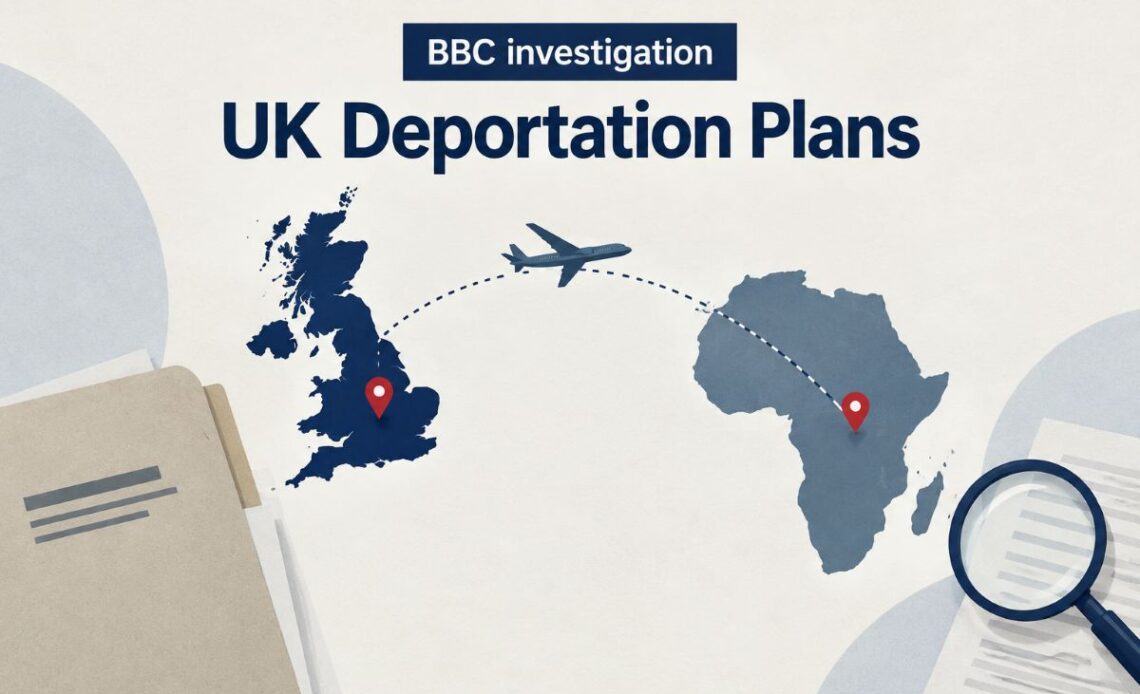
A refugee recognised as needing protection in the UK was secretly transferred to an African country with which he had no personal connection. The arrangement, uncovered by a BBC investigation, was not disclosed to Parliament or the local community in advance. The case raises serious questions about government accountability, refugee protection and Britain’s growing interest in sending people who have no right to remain in the UK to other countries.
What’s actually true about the secret refugee deal?
The case concerns Kishanth Peramalya, a Sri Lankan national who was recognised as a refugee after being rescued by the Royal Navy in the Indian Ocean in 2021.
According to the BBC, Peramalya had a history of severe mental illness and suicide attempts. After spending time on Diego Garcia, a British Indian Ocean Territory, he was transferred to Eswatini, a landlocked country in southern Africa.
The arrangement was unusual because he had no established connection with Eswatini. The BBC obtained a draft agreement between the British and Eswatini governments which reportedly committed the UK to covering his resettlement costs for up to three years.
Peramalya died by suicide months after arriving in the country. The UK government had been finalising arrangements for him to live there permanently.
Migration experts told the BBC that this appeared to be the first known case of the British government forcibly resettling a refugee permanently overseas.
The government has told the BBC that protecting the British public remains its priority and that it continues to work with Eswatini’s authorities on the case.
His family’s demand for answers has brought renewed attention to how vulnerable refugees are assessed, transferred and supported when governments arrange international resettlement.
How does this connect to Britain’s wider immigration plans?
The Eswatini arrangement comes at a time when the UK is reconsidering how it deals with people who have exhausted their asylum claims or have no legal right to remain.
The previous Conservative government introduced its controversial Rwanda policy in 2022. It was designed to transfer certain asylum seekers arriving in the UK to Rwanda, where their claims would be processed.
However, the Supreme Court ruled the policy unlawful in November 2023, citing concerns about the risk of refugees being returned to countries where they could face persecution. Labour subsequently abandoned the scheme after taking office in 2024.
But the wider debate has not disappeared.
The current government has explored the possibility of sending failed asylum seekers to third countries when removal to their country of origin is not possible. A third country is simply a country other than the UK or the person’s home country.
In November 2026, discussions between the UK and European partners also brought renewed attention to proposals for overseas return hubs. These would potentially allow people whose asylum applications have been refused to be transferred elsewhere while arrangements for their removal are made.
The important distinction is that a failed asylum seeker and a recognised refugee are not the same thing. Someone whose asylum claim has been refused does not automatically have the same legal position as someone who has already been granted refugee protection.
Common misconceptions about the case
Does this mean the UK can send any refugee abroad?
No. Refugees have legal protections under international and domestic law. A government cannot simply transfer someone to another country without considering their protection needs, individual circumstances and the risk of onward removal to danger.
Is the Eswatini arrangement the same as the Rwanda policy?
No. The Rwanda policy was designed to transfer certain asylum seekers for processing. The Eswatini case involved the relocation of an individual who had already been recognised as a refugee.
Does keeping an agreement secret automatically make it illegal?
Not necessarily. Some diplomatic arrangements are not publicly disclosed. However, secrecy raises legitimate questions about parliamentary scrutiny, transparency, legal safeguards and accountability.
What happens next, and what should people know?
The immediate questions concern the circumstances of Peramalya’s transfer, the support he received after arriving in Eswatini and the extent of the UK government’s responsibility for his welfare.
For people following Britain’s immigration policies, it is worth distinguishing between proposals, signed agreements, and policies that are actually in operation. Political announcements do not automatically mean that deportations or overseas transfers can begin.
Anyone affected by an asylum or immigration decision should seek advice from a qualified immigration solicitor or an authorised immigration adviser. The Home Office and GOV.UK remain important sources for checking current rules and official announcements.
Key takeaways
The BBC investigation has exposed an unusual overseas resettlement arrangement involving a recognised Sri Lankan refugee who was transferred to Eswatini without a publicly disclosed agreement.
The case is not proof that Britain can freely deport recognised refugees. Instead, it highlights the need for proper legal safeguards, transparency and accountability whenever vulnerable people are transferred between countries.
As the UK considers closer cooperation with other countries on immigration enforcement, the central question is not simply where people can be sent, but whether their rights and safety will be protected.